
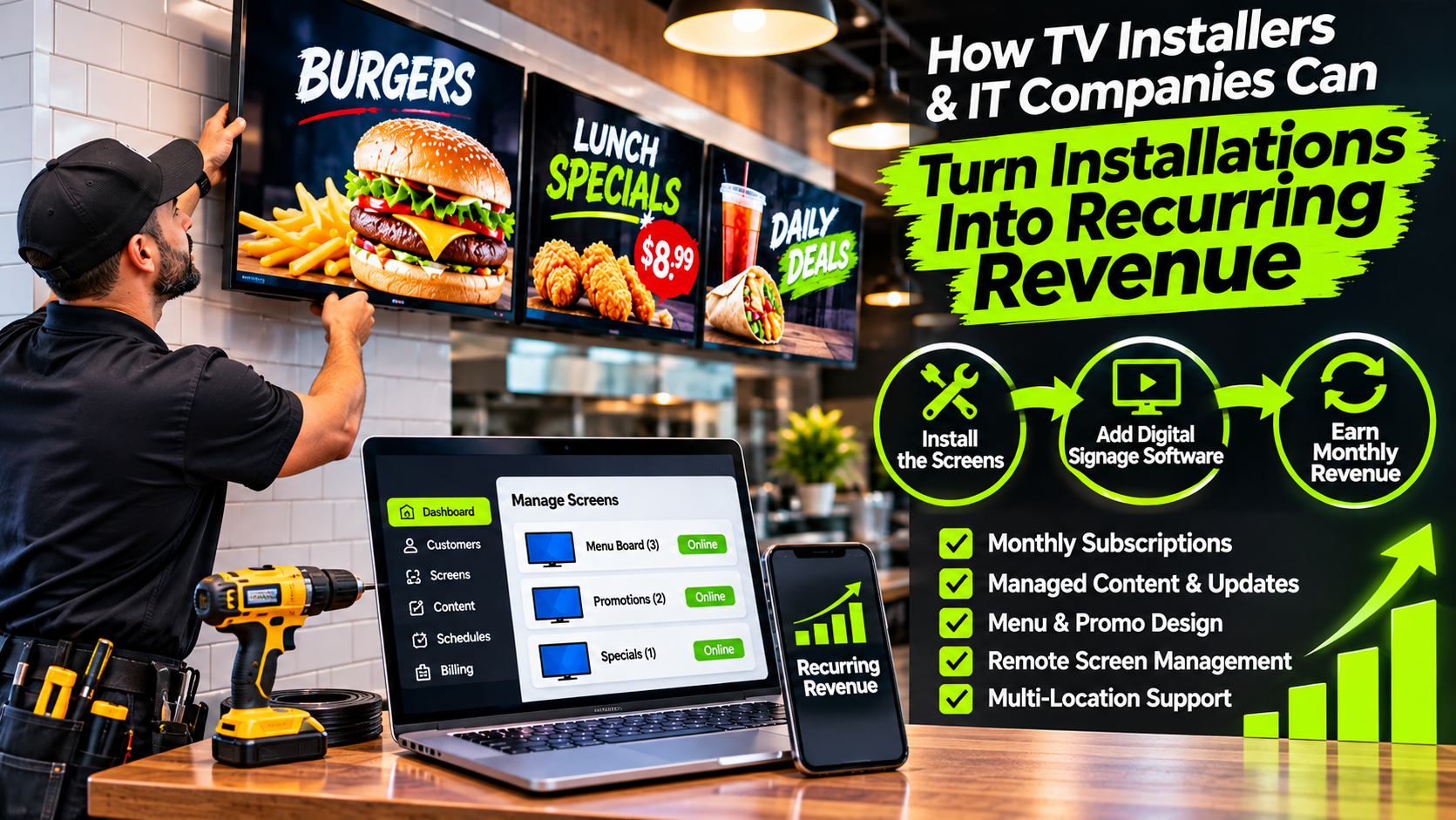
For television installation companies, audiovisual (AV) contractors, and managed IT service providers, one of the biggest business challenges is generating consistent revenue. Installing televisions, configuring equipment, and setting up networks can be profitable, but these projects are often completed in a single visit.
Once the installation is finished, the customer pays the invoice, and the service provider must find another project.
However, businesses that install and maintain commercial televisions have an opportunity to turn these one-time transactions into long-term customer relationships.
By becoming a digital signage reseller, TV installers and IT service companies can offer ongoing screen management, content updates, software subscriptions, and technical support while building monthly recurring revenue.
Instead of simply installing a television, they can provide a complete digital signage solution that continues generating revenue after the initial project is completed.
1. The Problem With One-Time Installation Revenue
Traditional television installation businesses depend heavily on new projects.
A restaurant might hire an installer to mount five televisions, connect streaming devices, and configure the displays.
Once the work is completed, the installer receives payment and moves on to the next customer.
Although the project generates immediate income, it doesn’t necessarily produce future revenue.
The same challenge applies to AV contractors and IT companies that install displays in offices, retail stores, conference rooms, and commercial buildings.
Without maintenance contracts or ongoing services, these businesses must continually acquire new customers to maintain revenue.
Digital signage management provides an opportunity to change that model.
By offering software subscriptions and managed services alongside installations, companies can create an ongoing relationship with the customer.
2. Turn Installed Televisions Into Digital Signage
Many commercial television installations already involve screens used for advertising, menus, announcements, or promotional content.
Restaurants install televisions above their counters. Convenience stores use screens to advertise products. Gyms display class schedules, and medical offices use waiting room televisions to share information.
These screens can often be converted into digital signage displays using compatible software and streaming devices.
For example, a restaurant that installs four televisions could use them to display digital menu boards instead of traditional cable programming.
With compatible Amazon Fire TV or Android TV devices, businesses can display images, videos, menus, and advertisements remotely.
This allows installers to offer more than hardware installation.
They can provide a complete solution that includes screen configuration, digital signage software, content setup, and ongoing management.
Before recommending a solution, installers should verify device compatibility, network reliability, and whether the displays are suitable for the intended operating hours.
3. Add Monthly Software Subscriptions
One of the simplest ways to create recurring revenue is to charge customers a monthly fee for digital signage software and basic screen management.
Instead of selling software as a separate product, installation companies can bundle it with their services.
For example, a TV installation company could charge $5 per screen monthly for software access and basic support.
A restaurant with five screens would pay $25 per month.
If the installer eventually manages 100 screens across multiple businesses, the monthly gross subscription revenue would reach $500.
While this may seem modest compared with a large installation project, recurring subscriptions can accumulate as the company completes more installations.
Platforms such as Billiie make this business model more accessible by offering affordable digital signage software and commercial reseller tools.
Billiie’s standard digital signage software starts at $1 per screen per month, while commercial reseller packages offer additional capabilities for managing multiple customers.
Resellers should review current subscription terms and screen limits when calculating their actual costs.
4. Offer Fully Managed Digital Signage Services
Many business owners don’t want to manage their television content themselves.
A restaurant owner may need to update menu prices, change daily specials, or advertise seasonal promotions.
A convenience store might want to promote new products or limited-time discounts.
Instead of asking customers to handle these tasks, installers and IT providers can offer a fully managed service.
A monthly package could include:
- Remote screen management
- Uploading new images and videos
- Updating digital menu boards
- Scheduling promotional content
- Monitoring screen connectivity
- Basic troubleshooting
- Coordinating content changes across locations
For example, a company could charge $10 per screen monthly for managed digital signage.
A customer operating five screens would pay $50 per month.
The company would then provide the agreed-upon content updates and screen management services.
Clearly defining the number of monthly updates, design revisions, and support requests included in each package helps protect profitability.
5. Use Centralized Software to Manage Multiple Customers
Managing digital signage manually becomes difficult as the number of customers increases.
Imagine an installation company with 30 customers, each operating several screens.
Some customers may need daily menu updates, while others only require occasional promotional changes.
Without centralized software, the company could spend considerable time visiting locations or accessing individual devices.
Billiie’s commercial reseller platform allows service providers to manage multiple customer accounts through a centralized dashboard.
Resellers can organize screens, upload content, schedule playlists, and remotely update displays.
For example, an installer could update a deli’s breakfast menu, schedule a gas station’s weekend promotion, and change a retail store’s advertisements without visiting each location for routine content changes.
The platform also provides screen status monitoring, helping service providers identify displays that may require attention.
This centralized approach allows installation and IT companies to expand their services without relying entirely on additional on-site visits.
6. Create Digital Signage Maintenance Packages
Managed IT providers are already familiar with recurring service contracts.
Many charge customers monthly for network monitoring, technical support, software maintenance, and equipment management.
Digital signage can be added to these existing service agreements.
For example, an IT company managing a restaurant’s internet connection, security cameras, and point-of-sale network could also offer digital signage monitoring and support.
A maintenance package might include checking screen connectivity, verifying content playback, assisting with device configuration, and troubleshooting software issues.
This can be particularly useful for businesses with multiple screens or locations.
Rather than contacting different companies for every technology issue, customers can work with one service provider.
For the IT company, digital signage becomes another service that can contribute to recurring monthly revenue.
7. Generate Additional Revenue From Design and Content Updates
Software subscriptions are only one part of the opportunity.
Businesses frequently need help creating content for their digital displays.
A restaurant opening a new location may require several digital menu designs.
A retail store may need promotional graphics for upcoming sales.
A gym might want advertisements for new membership packages.
TV installation and IT companies can offer these services directly or partner with freelance graphic designers.
For example, an installation company could charge a one-time fee for creating digital menu boards and then offer monthly content management.
This combines project-based revenue with recurring subscriptions.
It also allows companies to offer customers a complete solution rather than referring them to several unrelated service providers.
8. How Much Recurring Revenue Could Installers Generate?
Consider a television installation company that completes approximately 10 commercial projects per month.
If each project includes an average of four digital signage screens, the company could potentially add 40 managed screens monthly.
Assuming every customer enrolls in a $10-per-screen monthly service, the recurring revenue could grow as follows.
MonthTotal managed screensMonthly gross recurring revenue140$4003120$1,2006240$2,4009360$3,60012480$4,800
By month 12, the company would have an annualized recurring revenue run rate of $57,600.
This is a hypothetical scenario assuming 40 additional paying screens each month, no customer cancellations, and no changes in pricing. It is not a forecast or guarantee.
Actual results depend on the number of installations completed, customer adoption, retention, service costs, and operating expenses.
Nevertheless, the example illustrates how recurring revenue can accumulate alongside traditional installation work.
9. Target Existing Customers Before Finding New Ones
Installation and IT companies may already have a valuable customer base.
Rather than immediately investing in advertising, they can begin by contacting businesses where they previously installed televisions.
A restaurant that purchased five televisions last year may now want digital menus.
A convenience store may be interested in displaying promotional advertisements.
A gym may want to replace ordinary television programming with branded announcements and membership offers.
These existing relationships can make it easier to introduce digital signage services.
Service providers can offer a demonstration showing how a business owner can update content remotely without using USB drives or manually changing every television.
Companies can also include digital signage as an optional add-on in future installation proposals.
For example, a proposal for four commercial televisions could include hardware installation, device configuration, digital signage software, and an optional monthly management plan.
This gives customers a clear choice while creating opportunities for ongoing service revenue.
10. Expand Into Multi-Location Businesses
As an installation company gains experience managing digital signage, it can begin targeting larger customers.
Restaurant groups, convenience store chains, retail franchises, and multi-location businesses may operate dozens or hundreds of screens.
For example, a company with 20 locations and five screens per location has 100 screens.
At $10 per screen monthly, that customer could represent $1,000 in monthly gross recurring revenue.
Multi-location customers may also require new installations, replacement equipment, content design, and technical support.
Using centralized management software can make it easier to maintain consistent content across different locations.
However, larger contracts may also require service-level commitments, dependable technical support, and additional staff or installation partners.
Companies should evaluate these responsibilities before agreeing to manage large screen networks.
11. Build a Reseller Business Without Developing Software
One of the biggest advantages for TV installers and IT companies is that they don’t need to create their own digital signage application.
Developing software requires programming expertise, hosting infrastructure, device testing, security maintenance, and ongoing technical updates.
Instead, companies can use an established platform.
Billiie’s reseller program provides tools for managing multiple customer accounts, organizing screens, scheduling content, and supporting customer billing through Stripe integration.
This allows service providers to focus on installing equipment, serving customers, and delivering ongoing management services.
For companies already working with commercial televisions and business technology, digital signage can be a natural extension of their existing operations.
Final Thoughts: Turn Every Installation Into a Long-Term Opportunity
Television installers, AV contractors, and managed IT companies don’t have to depend exclusively on one-time installation revenue.
Digital signage creates an opportunity to turn commercial television projects into ongoing service relationships.
By offering monthly software subscriptions, remote screen management, promotional updates, and technical support, companies can build recurring revenue alongside their existing installation business.
Affordable platforms such as Billiie make it possible to provide these services without developing proprietary software or requiring every customer to purchase specialized signage hardware.
For installation and IT service companies looking to expand, the opportunity is straightforward: install the screens, help customers manage their content, and provide dependable ongoing service.
A single installation may last only a day, but a well-managed digital signage relationship can continue for years.